Your partner in neuromuscular diseases
The Danish Rehabilitation Centre for Neuromuscular Diseases (RCFM) is a center of excellence for neuromuscular diseases. For families. For health professionals. And for anybody else involved.
Who we are
Founded in 1976 by the Danish patient organization for NMD, Muskelsvindfonden, RCFM is a rehabilitation and research institute specializing in neuromuscular diseases (NMD).
The hospital is recognized as a specialized unit for neuromuscular rehabilitation by the Danish Health Authority. It is publicly funded, and its services are free of charge for patients. Approx. 3500 people with NMD are currently using our services.
RCFM’s staff is made up of doctors, nurses, physical therapists, occupational therapists, social workers, coordinators, psychologists, family therapists, researchers and communication officers.
What we do
A rehabilitation hospital
Rehabilitation our way
RCFM defines rehabilitation as a collaborative process which aims to ensure that persons affected by NMD make the most of their physical, mental and social resources. It is essential that rehabilitation goals are set together with the affected persons, their families, and affiliated professionals.
RCFM offers life-long counseling and guidance to individuals and families with neuromuscular diseases.
People/persons with a confirmed neuromuscular diagnosis can be referred to RCFM by the diagnosing hospital or their general practitioner. Most Danish patients who live with a severe neuromuscular diagnosis are referred to RCFM, and the hospital keeps records of almost the entire Danish population of patients with the diagnoses DMD, SMA II and ALS.
Partners in rehabilitation
In addition to supporting individuals and families with NMD, RCFM functions as a facilitator of intersectoral collaboration on rehabilitation in Denmark. By providing information and education about neuromuscular diseases, we support and supplement the rehabilitation services of the health care system, the social system and the private sector.


How we work with rehabilitation
Our patients are experts on their own lives, and knowledge sharing between patients and RCFM is mutual. We meet with our patients in the places where they are challenged by their disability in everyday life – at home, in school, and at work. We invite local professionals to help find solutions that are meaningful and empowering for both patients and the people who surround them.
Intervention process
Life-long rehabilitation requires interventions at different stages in life.
The intervention process at RCFM is cyclic, consisting of various stages as shown in the model:
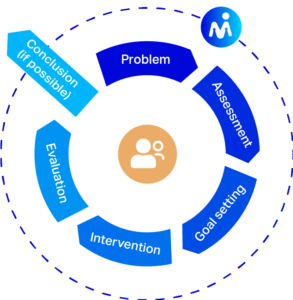
- The patient or a professional affiliated with the patient addresses a problem.
- The patient, relevant professionals and RCFM assess the problem and set a goal for the intervention.
- An appropriate intervention is identified and implemented.
- After a while, the parties evaluate the effect of the intervention; has the goal been met or are further interventions needed?
Below is a list of our core services which – except for patient education – all are based on the above model.
Our history
RCFM was founded in 1976 to meet the needs for specialized care for people with neuromuscular disorders.
Grassroot movement
”
People who live with neuromuscular diseases are experts on their own lives. RCFM are experts on neuromuscular diseases.
In 1971, the Danish patient organization Muskelsvindfonden was founded to protest the lack of information on neuromuscular diseases and thus the opportunities for people living with them. Some of the diseases were even considered hopeless by the doctors and thus not worth treating.
The aim of the organization was to improve treatment options and life conditions for people with NMD. With the establishment of RCFM in 1976, the organization now had two branches: a patient advocacy branch seeking political influence on behalf of its members and a health care facility offering patient education and guidance (måske også information to and networking with professionals)
Holistic treatment
RCFM’s mission was to offer a holistic treatment plan, focusing on the rehabilitation of entire person from a life-long perspective. Today this model is based on WHO’s Classification of Functioning, Disability and Health. Multidisciplinarity is key, and over time, the rehabilitation team has come to consist of doctors, nurses, physiotherapists, occupational therapists, psychologists, family therapists and social workers
Patient involvement has always been a central part of the rehabilitation effort based on the assumption that the patients are experts on their own life while RCFM and other health professionals are specialists on neuromuscular diseases.
